
Meeting the toileting challenge for children with disabilities
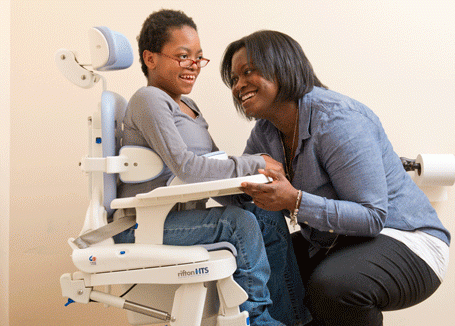
Welcome to the second Jiraffe blog – and this time we have a guest blogger – Elena Noble, a physiotherapist from American company Rifton.
Elena’s blog focuses on the challenges of toileting for children with multiple physical disabilities – and how the right environmental modifications and positioning aids can improve a child’s toileting skills and increase their independence levels.
The toileting challenge for children with disabilities
For a child with multiple physical disabilities, toileting can be challenging and difficult. However, if provided with the right environmental modifications and positioning aids, most children can improve their toileting skills resulting in effective elimination and increased independence levels. The question is how to best facilitate this outcome.
Transfers on and off the toilet are central to the toileting sequence and help build independence. Ironically, many parents discontinue their child’s toilet training routines precisely because lifting their child onto the toilet becomes too strenuous. However, if given the opportunity, children can learn to participate in these transfers.
For those who struggle with weight-bearing or walking, a vertical changing station or padded table can help them perform a pull-to-stand transfer. Their body-weight can be supported on the padded surfaces while carers adjust the clothing and roll a commode in from behind. The transfer to the toilet can then be used as an opportunity to practice sit-to-stand and weight-bearing skills at the same time. Ultimately, this will result in improved transfer skill performance and decrease the strain and risk of injury to the carer as they assist with these transfers.
Importance of optimal positioning
The next step is toilet positioning. Adaptations are usually necessary to accommodate deformities, muscle tone, and lack of postural control while at the same time ensuring that the child is stable, comfortable and positioned in the best possible way for effective elimination.
Without optimal positioning, children with disabilities may not be able to completely empty their bowel and bladder, putting them at an increased risk for urinary tract infections, constipation and other complications. Providing a feeling of stability on the toilet is key to this process. If children are well positioned and balanced in sitting, they will also be relaxed, which allows the abdominal muscles to relax. If children are continuously fighting to maintain an upright posture on the toilet, they will be unable to relax and concentrate on the toileting task at hand. The use of adaptive toileting chairs can help create an environment of stability and allow a child to comfortably maintain balance without fear of falling off the toilet.
What should you look for?
What constitutes an effective adaptive toileting chair? The recommended basics include a firm base of support with the feet planted, a good back support and a grab bar or other support in front.
As with active sitting, a forward positioning of the shoulders and upper extremities (as when holding on to or leaning against an anterior support) enables better head and trunk control and stability.
Ideally the lower limbs should be positioned in such a way that the knees are slightly higher than the hips, which aids better bowel and bladder elimination.
For children with extensor tone or poor postural control, additional seat-to-back angle adjustments or other external support systems may be necessary. In addition to feeling stable and relaxed on a toilet, the child also needs to feel comfortable. Children with disabilities often need more time to complete the toileting task, so comfort is important. Smooth contoured surfaces or padding on weight bearing surfaces can certainly provide an improved level of comfort.
Helping children lead independent lives
Essentially, for children with disabilities, toileting can be used as an opportunity to enhance skills and independence. The key is to find ways to make the toileting task easier and more effective, through improved methods of transfer and positioning. Adaptive toileting chairs can facilitate both – yet the design of such chairs has, until recently, fallen short in optimising positioning and comfort. With proper technique and proper equipment design, most children with disabilities can learn effective toileting and therefore achieve more fulfilling, independent lives.
Article based on paper by Elena Noble, MPT, for Rifton.