
Brady’s Story

 Brady is an 8 year old boy who has a diagnosis of Spastic Quadriplegic Cerebral Palsy (GMFCS Level V). He is non-verbal, but uses an app on his iPad and a communication book to aid his communication and understanding. Brady loves playing with his friends at school and enjoys computer games. Due to weakness and tone through his body, Brady needs support for all care and daily activities. Pre case study, Brady had access to a manual wheelchair which requires carer assistance for all mobility, and he was using a full body posterior support walking frame. Brady’s physiotherapist was keen to explore the inclusion of an adaptive tricycle alongside his typical therapy programme to assess the overall holistic benefits.
Study Period
Use of a Rifton Adaptive Tricycle was added alongside Brady’s existing therapy routine for a period of 6 weeks. Prescription of the tricycle was determined using UK Governmental guidelines for physical activity in disabled children and adolescents [1] and exercise recommendations for people with cerebral palsy [2]. As such, therapy staff tried to adhere to the following tricycle exercise programme for Brady: 20-30 mins of moderate intensity cycling, up to 5 times per week, over a 6 week period. Intensity of cycling was determined via therapist assessment and discretion.
Initial Assessment
On the first assessment with the Rifton Tricycle, Brady was unable to propel and pedal the tricycle independently, and needed significant support for all turning and navigation.
Results
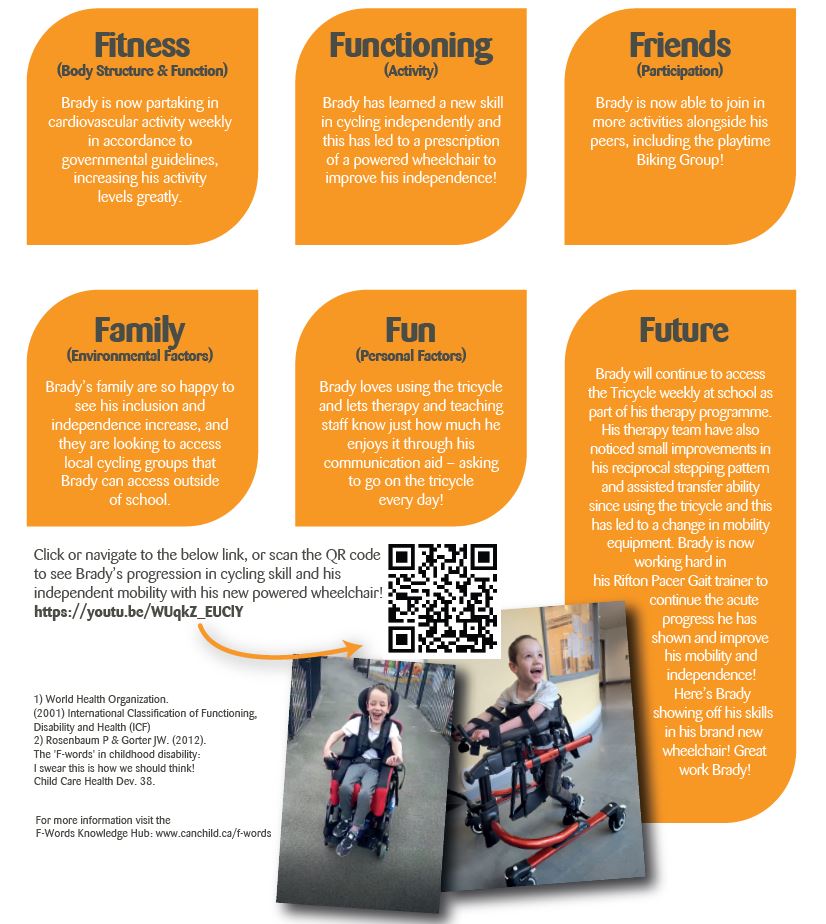
After 6 weeks of using the Tricycle Brady was able to:
- Push off and pedal the Tricycle independently
- Turn the tricycle independently on wider turning circles
- Join in in playtime cycling groups with his peers
Comments from Brady’s Physiotherapist: “Brady initially struggled to pedal independently and really struggled with turning the tricycle. He is now able to push off and pedal independently and is working hard on independent steering. As a result of his improvement and control when steering the tricycle, he was referred for a powered wheelchair assessment. The assessment was a resounding success and he is now awaiting his new chair to improve his
independence and mobility around school! Brady thoroughly enjoys using the tricycle in school – there’s no such thing as ‘too much time’ on the trike for him!”
Comments from Brady’s Teacher: “Brady loves the tricycle! It has been really pleasing to see how access to the tricycle has opened up new experiences and social opportunities for him. He is now playing with friends in a ‘Biking Group’ at playtime and it’s exciting that he has been referred for a powered wheelchair assessment. As a team, we were unsure how well he would be able to use the tricycle due to his disabilities, but we have been astounded with
his progress.”
Comments from Brady’s Mum: “I have never seen Brady cycle and, in truth, I never believed he would be able to it. It made me really happy to see him pedalling independently and he always seems so excited when using the tricycle too. It is great that he can access the tricycle to join in with friends at school. Brady is always so happy whenever he is using the tricycle and has been using his communication aid to ask teaching and therapy staff to bring out the Tricycle daily!”
1) 1. UK Chief Medical Officers’ Physical Activity Guidelines for Disabled Children and Disabled Young People 2022. Retrieved from
2) Verschuren, O. et. al. Exercise and Physical Activity Recommendations for People with Cerebral Palsy. Dev Med Child Neurol.
2016; 58(8): 798-808