
Harrison’s Story

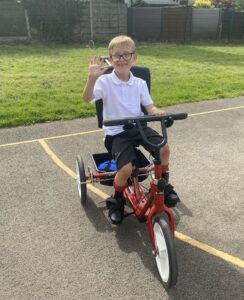
 Harrison is 7 years old. He is a football fanatic and is a huge Manchester United supporter. He likes Harry Potter, gaming on his PlayStation and going to the play centre with his family. His favourite food is fish fingers. Harrison was born with Spina Bifida and Hydrocephalus. There are several different types of Spina Bifida, and Harrison has a diagnosis of Myelomeningocele.
Learn more about Myelomeningocele and Hydrocephalus here:
- https://www.nhs.uk/conditions/spina-bifida/
- https://www.shinecharity.org.uk/
Harrison is affected by lower limb weakness, paralysis and loss of sensation, particularly below his knees and at his feet. He has difficulty mobilising over longer distances and struggles with his balance. He wears ankle foot orthoses to support his foot posture bilaterally. Despite these difficulties, Harrison loves keeping active and is a determined young man who works hard to overcome any challenges he faces. Harrison’s physiotherapist and teaching staff were keen to explore the inclusion of an adaptive tricycle into his daily school routine to see if this positively impacted his mobility, functioning and quality of life.
Study Period
Use of a Rifton Adaptive Tricycle was added alongside his existing therapy routine for a period of 8 weeks. Prescription of the tricycle was determined using UK Governmental guidelines for physical activity in disabled children and adolescents [1]. As such, the tricycle exercise programme for Harrison was the following:
20-30 mins of moderate intensity cycling, 3-5 times per week, over an 8-week period. Intensity was measured by wearing a sports watch and aiming for between 50-70% of his maximum heart rate (calculated by subtracting his age from 220).
Outcome Measures
Outcome measures assessed pre and post-study were distance covered during the 1-minute walk test (median taken from 3 attempts), Harrison’s score on the Paediatric Balance Scale and the Jiraffe Quality of Life Questionnaire.

On the first assessment with the Rifton Tricycle, Harrison needed assistance turning the handlebar and to step on and off the tricycle safely. He also struggled pedalling independently when the terrain became more inclined or generally more challenging.
Results
 In just 8 weeks:
Harrison’s Paediatric Balance Scale score improved from 36 to 44 out of 56 and his distance covered over the 1-minute walk test increased from a median of 67 metres to 76 metres! His score on the Jiraffe Quality of Life Questionnaire improved from 38 to 44 out of 50. Notable improvements were
found under the following statements:
- ‘I can take part in the same activities as my friends’
- ‘I feel no different to my friends’
- ‘I am independent with most things I do’
- ‘I can move my arms and legs well’
After the 8 weeks of using the trike Harrison was able to:
- Get on and off the trike independently
- Steer independently – he no longer needs the assistance of the guide bar/support staff at school
- Pedal fast!
- Pedal uphill independently – working his lower limbs and core really hard!
Harrison said these are the three things he most likes about the adaptive tricycle:
- How fast he can now go!
- How much fun he has whilst riding it.
- That he has learnt to do something new
Comments from Harrison’s Physiotherapist: “Harrison has made great progress with his mobility and balance whilst using the tricycle and it has been great to see how much he has enjoyed using it. Well done, Harrison!”.
Comments from Harrison’s Teaching Staff: “From day one of Harrison going on the trike I’ve seen nothing but joy on his face every time we use it and excitement in his voice when he tells people about it. I am extremely happy to say that since he has been on the bike the strength in his legs has improved greatly, which is such a fantastic achievement”.
Comments from Harrisons Mum: “Harrison had never cycled before, but now he loves using the tricycle at school. It has been lovely to see how much fun he has had and how much progress he has made”.
After the case study had started, Harrison experienced a short period being partialweight-bearing only due to skin pressure changes on his feet. He was predominantly using his wheelchair and standing to transfer only. The adaptive tricycle provided an important option for continued mobility with partial weightbearing and for maintaining strength during this period.

Summary
These results could suggest that use of an adaptive tricycle as a cardiovascular exercise, in conjunction with Harrison’s existing therapy programme, may have had positive acute effects on his function, gait efficiency, balance and quality of life, whilst also offering an alternative form of mobility when his weight bearing status was limited. It highlights acute functional gains can be made in the presence of permanent weakness and paralysis. It is also further evidence that adaptive cycles are fun and encourage inclusion/interaction with friends.

1) World Health Organization. (2001) International Classification of Functioning, Disability and Health (ICF)
2) Rosenbaum, P. & Gorter J. The ‘F-words’ in childhood disability: I swear this is how we should think!
Child: care, health and development. 2011; 38(4): 457–46
For more information visit the F-Words Knowledge Hub: www.canchild.ca/f-words