
Case Study: Alice’s Story


Meet Alice, a bubbly teenager, who enjoys getting out and about. The 14-year-old lives in Whitefield with her mum, Lisa, dad, Tony, brother, Mani, sister, Molly, and Stan the pug.
She’s such a social butterfly – she loves nothing more than going to the cinema or the zoo. And she really loves music, especially playing with her musical toys. When she’s at school (Firwood High School in Bolton), she enjoys swimming in the hydrotherapy pool, rebound therapy and singing her heart out in the school choir.
Alice is a truly remarkable young lady. She was diagnosed with Grade 3 Hypoxic-Ischemic Encephalopathy when she was born. The brain injury caused lifelong disability, which has severely affected her functioning and posture. Alice has Cerebral Palsy and weakness throughout her entire body, which means she cannot lie, sit or stand without significant support. She also has dislocated hips and a significant curvature in her spine.
Click here to find out more about ‘Hypoxic-Ischemic Encephalopathy’
Alice requires 24-hour care to keep her posture aligned. She has already undergone multiple surgeries throughout her young life, including a tracheostomy to help her breathing. Alice has also subsequently experienced some life-threatening issues, which were caused by the tissue around her tracheostomy growing too much.
Why Alice needed our help
Standing has always been difficult and uncomfortable for Alice and she has always needed a a standing frame to enable her to be in an upright position.
 Over the years, her family had struggled to find a frame that could support Alice’s postural needs and adapt to her posture as she develops. Her progressive spinal scoliosis has made her trunk a little wider. However, her height has become smaller, making sizing difficult.
Up until recently, Alice spent very little time standing up because it hurt her so much. She was also at risk of her skin breaking down. Despite her determination, she had recently got to a point where supported standing was too painful and was putting her at risk of skin breakdown.
How we helped Alice and her family
Alice trialled the Size 3 Supine Stander, which has been a game-changer for her and her family. Thanks to the flexible design, which means the system is small enough for her height and wide enough to support her spine, standing is now an option again. Following the successful trial run, a Supine Stander has been ordered for Alice to use at school.
“She would stand longer than an hour a day if she could. It’s great to see Alice not in her chair, and she can do all of her favourite activities standing up. The tray is an amazing accessory to help her play,” explains her mum.
“Standing with the help of gravity really helps with her bowel movements as Alice has major difficulties with constipation. Standing also helps calm her breathing and increase her breathing capacity. Alice is so happy, comfortable and really enjoying her new standing frame!”
“It’s great to see Alice not in her chair, and she can do all of her favourite activities standing up.”
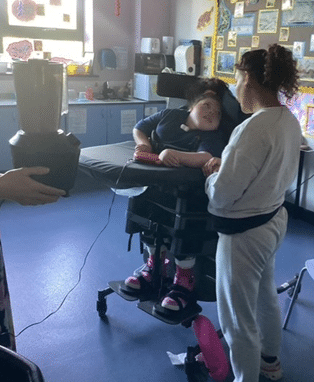 Why the Supine Stander has transformed Alice’s life
The highly tailored support provided by the Supine Stander combined with the pioneering functionality has made what was once impossible, possible:
The customised supports expert align with her body – Alice needs bespoke postural support, and the Supine Stander provides just that. For example, her Supine Stander incorporates flexible thoracic support pads that are positioned asymmetrically to comfortably support her fixed scoliosis – a size 3 flexible thoracic is used to support the large convex curve on her right side, and a smaller size 2 flexible thoracic is used on her left, which accounts for the fact she leans down to the side more.
The multi-grip headrest – can be adjusted to support Alice’s posture. Historically, the headrests that been used in the past used to place her head in a midline position which isn’t practical because of her fixed posture. This made breathing through her tracheostomy extremely difficult. Constant rubbing against these headrests also resulted in her skin becoming irritated and sore. The highly adjustable nature of the multi-grip headrest means Alice is fully supported, her airway is unobstructed and her head is comfortable and less likely to be impacted by pressure care issues.
The tray – is sturdy and supports Alice’s favourite musical toys. The bowl enables her to enjoy fun sensory exploration while the soft padding provides a different sensory
experience and layer of comfort. The height of the tray can be easily adjusted, supporting Alice’s upper limb functioning.
The electronic adjustment – means Alice can easily go from horizontal to standing with ease. The process is steady and controlled, enabling her to adjust to the new position without feeling dizzy or disorientated.
Please click here to download Alice’s Case Story


About the Author
Kieran qualified as a Physiotherpist in 2016 at the University of Salford and later attained an MSc at the same university in Advanced Physiotherapy. He completed his core rotations before becoming a senior paediatric physiotherapist for the NHS in Greater Manchester, UK.
Kieran’ s experience as a physiotherapist has seen him provide a wide range of holistic therapy to children with developmental delay, complex neurological and physical disabilities and musculoskeletal injuries. He continues to work alongside his role as Clinical Partnerships Manager for Jenx with a small caseload of private patients and as a locum therapist.
Kieran has a keen interest in supporting adolescents with cerebral palsy and the management of hip dysplasia.
References
1) World Health Organization. (2001) International Classification of Functioning, Disability and Health (ICF).
2) Rosenbaum, P. & Gorter J. The ‘F-words’ in childhood disability: I swear this is how we should think!
Child: care, health and development. 2011; 38(4): 457–46.