Understanding Prone Vs. Supine Standing
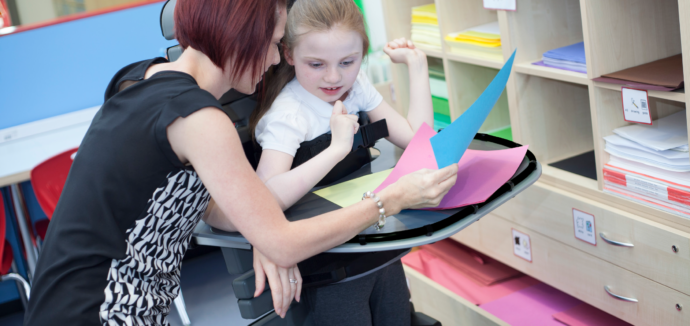
For children and adults with more complex physical disabilities or limited movement, adaptive equipment can be essential in the fundamental development of body structures, internal system functionality, and participation in daily life. For many individuals, standing can be one of the greatest deterrents against issues that arise from the sedentary behaviours associated with reduced mobility. Understanding the difference between standing frame options is paramount in selecting the most suitable equipment for each individual.
Prone Standing
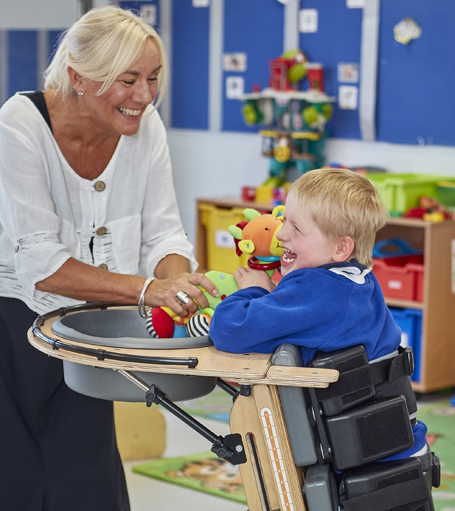

A prone stander offers supportive standing to the individual via aid in front of the user. Supporting individuals in an anterior position is a great way to work on the development of muscle control for the head, neck and trunk, using gravity to challenge these areas. Typically, users of prone standers can assist in the transfer into the frame in some way – for example, a handheld sit-to-stand transfer. However, some users may use a standing sling or small children may be lifted into the frame.
Typically, the prone standing frame can be tilted from upright to provide a range of angles in a forward-facing stance. This can be useful for using gravity to challenge head upper trunk and neck control or to stretch tight musculature, such as hip flexors.
In the prone position, individuals can typically interact with their peers at eye level. The design allows free motion of arms and hands for the development of gross and fine motor skills.
Supine Standing
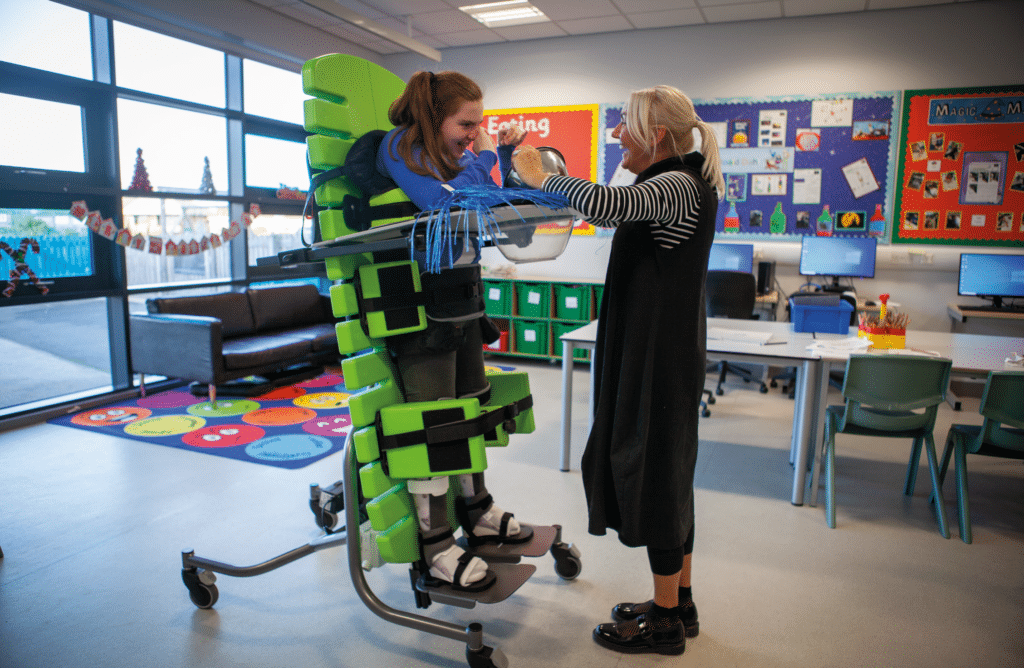
A supine stander supports users from behind by gradually transitioning individuals from a lying position to upright. Supine standers feature the ability to tilt a varying range of degrees, and are adjustable to the individual needs of the adult or child. By supporting from behind, supine standers become especially useful for users who have little head or neck control and they are accommodating of more complex, asymmetrical postures whilst still enabling the user to experience other benefits of being upright against gravity.
Standing as upright as possible for the individual’s needs may help them develop bone density, improve circulation, digestion and postural control. It is also a great way to reduce sedentary behaviour and break up prolonged periods of sitting or lying. Supine standers are designed to allow easy transitioning for carers, physiotherapists and family members with some systems equipped with battery operation and backup power for safeguarding practices.
Multistanders


A multistander offers the flexibility to accommodate both prone and supine positioning. This is ideal for users who require varying postural support throughout different development growth stages which can be helpful for progressing skill or accommodating regressive conditions. Multistanders can also be beneficial for multi-use settings, whereby more than one child might access the same standing frame. Multistanders provide carers and physiotherapists with the ability to adjust positioning when required, offering a dynamic and cost-effective approach to postural care.

The Benefits of Standing Frames
Whether prone, supine, multi-position, or standing frames provide valuable support and benefits for individuals across the world. Standing offers a wealth of benefits, including:
Improved Bone Density
Weight-bearing promotes bone development and strength.
Promote Hip Health
Standing and weight-bearing age appropriately plays a huge role in the development of our skeletal system. Supported standing may aid the formation of stable and more typical ball-and-socket hip joints. A hip abduction feature may help with gentle stretching on tight hip adductors, maintaining range of motion, and hip joint loading for optimal development.
Digestive Support
Standing aids healthy digestion and increased bowel functionality.
Postural Alignment and Ability
Adaptable standing frames can encourage improved postural control, reduce postural asymmetry and develop skills.
Social Engagement
Valuable independence and relationship building are gained through eye-level interaction with peers.
Ease of Use
Manual handling needs and care burdens can be reduced through battery-operated support, adjustability, and environmentally-minded designs.
Understanding the F Words?

Copyright of Ginny Paleg and Roslyn Livingstone.
[2] Image from: “Supported Standing and Supported Stepping Devices for Children with Non-Ambulant Cerebral Palsy: An Interdependence and F-Words Focus” Paleg & Livingstone (2024).
Showing F-words comparison of clinical evidence for supported standing and stepping devices.
Case Studies
Click here to read Ava’s story and see how Standz and Junior support her development.
Click here to read Madison’s story and learn how the Supine Stander helps with movement and play.

Providing Postural Care Throughout Life
In 24-hour postural care, standing frames provide a crucial role in improving the quality of life for individuals with complex disabilities or limited mobility. At Jiraffe, our ethos is to provide support for life and make a positive difference to the child and their family. We offer supportive standing frames from infancy to adulthood, and training and education for therapists, carers and families to help them understand the need and application of our equipment.
Selecting the correct standing frame is paramount to the most successful outcomes, which is why we actively encourage demonstrations and provide professional guidance upon request. To understand the maximum benefits and long-term support of the Jiraffe by Jenx standing frames, book a demo or contact a member of our team today.